The scenario is always the same. The extension goes on the back, the floor build-up allows for underfloor pipes, and somebody asks the obvious question: can we just run it off the existing boiler?
Yes. But not by connecting it to the same pipework and hoping, because there are two separate obstacles in the way and they have separate solutions. The first is temperature, since underfloor heating wants roughly 35 to 45 degrees flow and radiators sized decades ago want considerably more. That is solved at the manifold with a blending valve. The second is hydraulic, because you now have two pumps in one system, and the usual fix there is a low loss header, which lets each circuit draw the flow it needs without stealing from the other.
Almost every problem with these installations comes from treating those two as one issue. So take them in order.
Two temperatures from one appliance
Underfloor heating cannot take boiler flow temperature and there are three reasons, only one of which is about comfort.
Floor surface temperature is limited for physiological reasons, generally to around 27 to 29 degrees in occupied areas, higher in bathrooms and at the perimeter. Push the water temperature up and you exceed that long before the room gets any better. Screed itself does not enjoy sudden high temperatures either, particularly during the first heating cycle after laying, where a controlled ramp is specified for a reason. And the pipe, usually PE-RT or PEX with an oxygen barrier, has a pressure and temperature rating that assumes low temperature service.
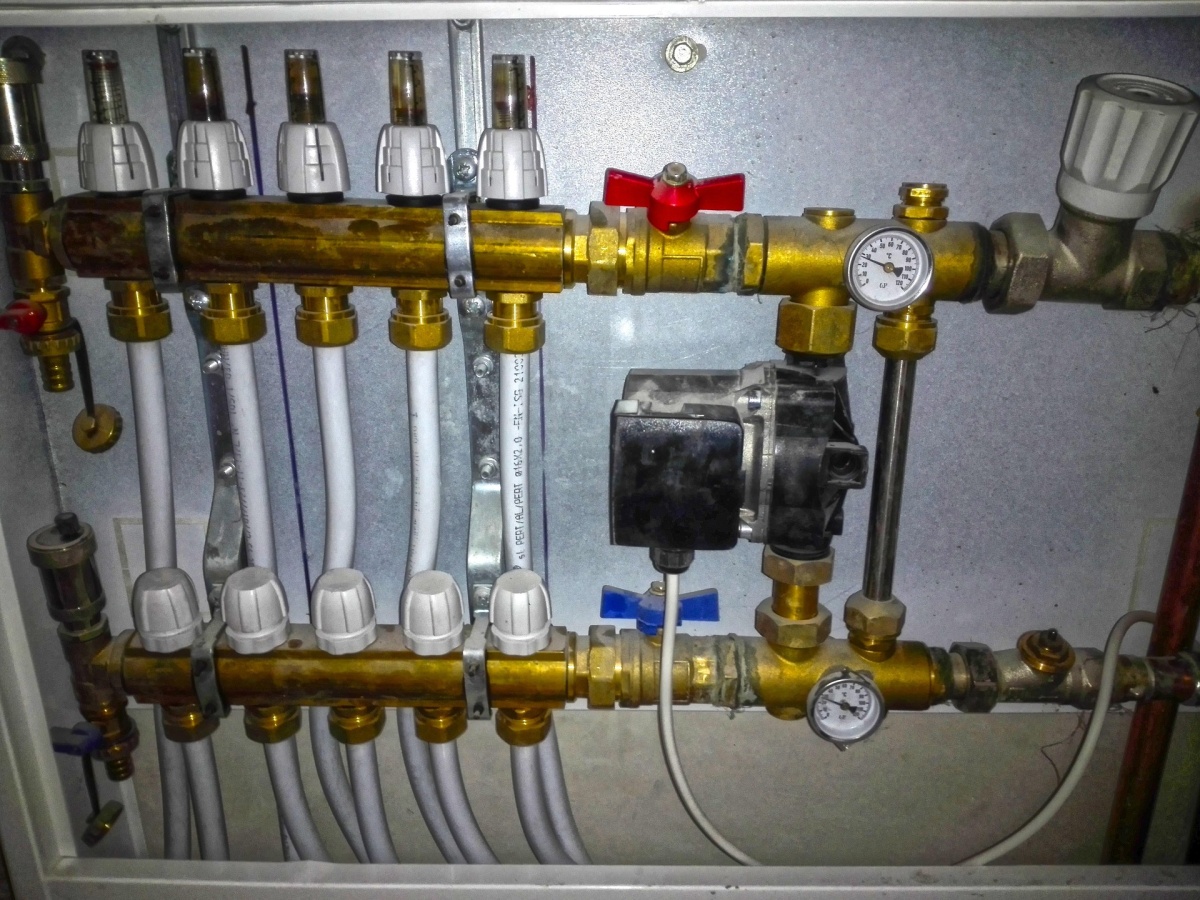
The solution is a mixing manifold. Boiler flow arrives at the manifold, a thermostatic or motorised blending valve mixes it with return water from the loops until it hits the set point, and a small circulator pushes that blended water around the floor. The manifold has flow meters on one side for balancing each loop and actuators on the other for room by room control.
Worth knowing where the regulations now sit. In England, Approved Document L expects new or full replacement wet central heating systems to be sized for a maximum flow temperature of 55 degrees where practicable, and the lowest achievable temperature where it is not. Wales and Scotland have their own arrangements, so check which applies before designing. The practical effect is that the gap between what radiators want and what the floor wants has narrowed considerably compared with a traditional 75 degree system, which makes mixed installations easier than they were, provided the radiators are sized for the lower temperature rather than inherited at whatever size they happen to be.
The problem the mixing valve does not touch
Now the part that actually causes the callbacks.
Your boiler has a pump. Your underfloor manifold has a pump. Connect both to a common set of pipes and those two pumps are not co-operating, they are interacting. Each one creates a pressure differential across a circuit that the other is also trying to control.
What happens next depends on the layout, but the patterns repeat:
- Flow takes the path of least resistance, which is almost always the short fat run to the new extension, and the far end of the radiator circuit runs lukewarm
- The boiler sees a flow rate outside its design window, either too low when zones close or too high when both call, and starts short cycling
- Return temperature climbs because blended water is being recirculated where it should not be, and the boiler stops condensing, which quietly removes the efficiency you paid for
- Behaviour changes depending on which zone is calling, so the system works fine when you test it and misbehaves in real use
Homeowners describe this as the floor being lovely and the upstairs never getting warm. It is not a sizing problem and turning the boiler up does not fix it. It is a flow problem.
What a low loss header actually does
It decouples. That is the whole function, and it is worth being precise about it.
The header is a vertical vessel with the boiler flow and return connected on one side and the system flow and return on the other. Because the vessel's cross-sectional area is much larger than the pipework, water entering it slows down almost to a stop. The primary pump circulates through the boiler and into the header. The secondary pumps draw from the header into their own circuits. Neither pump can impose a pressure differential on the other, so each circuit gets exactly the flow rate its own pump is producing, no more and no less.
Two useful side effects come free with that drop in velocity. Air, which will not release in fast-moving water, rises out at the top, which is why these vessels have an automatic air vent up there. And heavier debris, magnetite in particular, falls out and collects at the bottom, which is why they have a drain valve. It is not a substitute for a filter and an air separator, but it helps.
Sizing follows the flow rate, not the boiler output on its own. The vessel has to be large enough that velocity inside it drops far enough for the decoupling and the separation to work, and the commonly quoted rule of thumb puts the body diameter at around three times the connection diameter. Confirm that against the manufacturer's selection data for the specific unit, because designs differ and getting it wrong produces a header that behaves like a piece of pipe.
Multi-tapping and distribution versions are worth knowing about for a job like this. Instead of a plain header plus a separate manifold plus a set of pump groups, you get the separation and the distribution in one component, with tappings for each secondary circuit. In a small plant room or a cupboard under the stairs, which is where most of these installations end up, that saves a surprising amount of space and a lot of jointing.
Header, buffer or volumiser, because they are not the same
These three get used interchangeably in conversation and they solve different problems.
A low loss header decouples flow rates. It holds very little water and adds almost no thermal mass.
A buffer cylinder adds volume specifically to stop an appliance short cycling, which matters most on heat pumps and on oversized boilers serving small zones. It decouples too, but its job is thermal.
A volumiser is simply extra system volume in a can, added to satisfy a minimum volume figure in a manufacturer's manual, with no separation function at all.
Picking the wrong one is common. If the complaint is uneven flow, a buffer is an expensive way to not fix it. If the complaint is a boiler firing for ninety seconds at a time, a header will not help.
Controls are half the job
Zone the two systems independently, each with its own two port motorised valve and its own thermostat, wired through a wiring centre so the boiler only fires when something is genuinely calling. Interlock matters: a boiler firing into a system with all valves closed is both wasteful and hard on the appliance.
Weather compensation suits mixed systems particularly well, because it drops the primary flow temperature in mild weather, which is exactly when the radiator circuit does not need 55 degrees and the floor certainly does not.
Then balance it. Lockshield valves on the radiators, flow meters on the underfloor manifold, and enough time on commissioning day to actually set them. This is the step that gets cut when a job runs late, and it is the step that determines whether the far bedroom works.
Questions that come up on extension jobs
Can underfloor heating and radiators run off one boiler?
Yes, routinely. They need different flow temperatures, which is a manifold job, and usually hydraulic separation, which is a header job.
Do I need a low loss header or a buffer tank?
A header if the problem is two pumps and uneven flow. A buffer if the problem is short cycling or a minimum volume requirement. Sometimes both, but for different reasons.
Will underfloor heating work at radiator temperatures?
No. It will overshoot the permitted floor surface temperature, risk the screed and the pipe, and still not control well.
Does a header reduce efficiency?
Only if it is badly sized or badly piped, in which case it can raise return temperature and stop the boiler condensing. Sized and connected correctly, it improves matters by letting each circuit run at its design flow rate.
Four numbers should exist on paper before anything is ordered: the heat load of each zone, the design flow rate of each circuit, the design flow temperature of each circuit, and the connection sizes those flow rates demand. Every component choice above follows from those four, and every argument on site happens because somebody skipped them.